Madeira beaches and natural pools: where to swim
Madeira is not a sandy-beach island: most of its beaches are pebble or dark sand, and its best-known sand beach, at Calheta, is man-made. The best swimming is in the lava-rock natural pools at Porto Moniz and in sheltered coves; for a long golden beach, take the ferry to Porto Santo. The sea ranges from about 18 °C in winter to 24 °C in summer.
By the Things to Do in Madeira editorial team · Updated 25 Nov 2026 · Facts checked 25 Nov 2026 · Tour prices and ratings from GetYourGuide, checked 25 Nov 2026
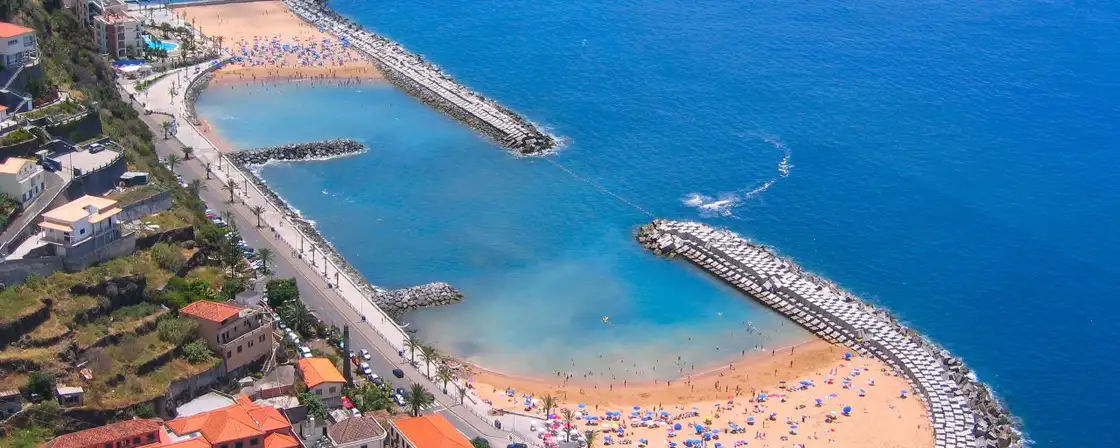
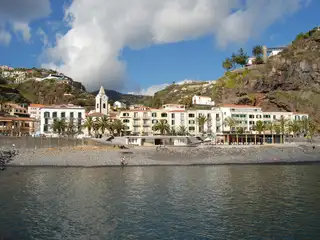
Calheta's sheltered sand beach and marina, seen from above. Photo: Don Amaro from Madeira Islands, Portugal, CC BY 2.0.
On this page
The main places to swim
| Place | Type | Cost | From Funchal |
|---|---|---|---|
| Porto Moniz natural pools | Managed lava-rock pools, lifeguard post | About €3, reported; no official price list 1 | about 55 min 2 |
| Cachalote pools, Porto Moniz | Natural rock pools | Free 3 | about 55 min |
| Calheta | Sheltered man-made sand beach, 100 m 4 | Free | about 35 min |
| Seixal | Black sand below green cliffs 5 | Free | about 50 min |
| Praia Formosa, Funchal | Pebbles and dark sand; the largest public beach 6 | Free | In Funchal |
| Porto Santo | 9 km of sand 7 | Ferry €58.90 or €72.02 return plus fuel surcharge 8 | 2 h 30 min by ferry 9 |
Sea temperature
Visit Madeira gives the sea as about 18 °C in winter and 24 °C in summer 10. Our satellite data show the warmest water in September and the coolest in March 11. The Atlantic swell matters more than the temperature: the north coast is more exposed, and the south is usually calmer and drier 12.
Natural pools versus beaches
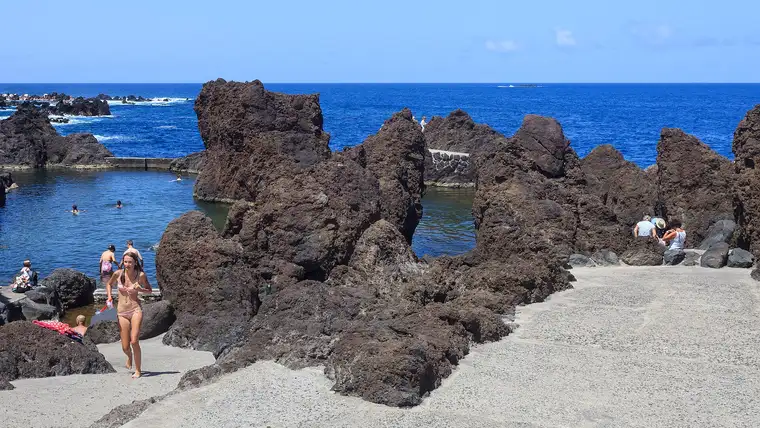
The natural pools at Porto Moniz are the island’s signature swim: lava rock and low walls hold the Atlantic in pools about two metres deep, with a children’s pool, changing rooms and a first-aid post 13. The Cachalote pools nearby are free but have no toilets 3. For a lazy beach day with children, sheltered Calheta is easiest.
Sand: Calheta or Porto Santo
Calheta’s beach opened in 2004 as Madeira’s first man-made beach, with sand from Morocco 4. If sand is the point of your holiday, Porto Santo, 2 hours 30 minutes away by ferry, has 9 km of it 7,9. See Porto Santo for the ferry and a day-trip plan.
Snorkelling and kayaking
The Garajau marine reserve east of Funchal is the place for a guided kayak and snorkel trip.
We earn a commission if you book through our links to GetYourGuide, Viator or Trip.com, at no extra cost to you; it never changes our picks. How this works
-
Kayak and snorkel tour in the Garajau nature reserve
Best active sea trip · Garajau / Caniço (per listing) · 3 hours · No entry fees involved
Guided paddle and snorkel in the Garajau marine reserve.
See prices and dates on GetYourGuide 4.9 (1,223 reviews on GetYourGuide) from €35 per person checked 25 Nov 2026 See today's price and rating on GetYourGuide -
West Madeira 4x4 day: Skywalk, Porto Moniz, Seixal and Fanal
Best first full day · Hotel pickup (areas per listing) · 8 hours · Skywalk and pool fees: check the listing
Stops at the Cabo Girão skywalk, the Porto Moniz lava pools, Seixal and the Fanal laurel forest; check the listing for which entry fees are included.
See prices and dates on GetYourGuide 4.9 (10,212 reviews on GetYourGuide) from €65.48 per person checked 25 Nov 2026 See today's price and rating on GetYourGuide
Questions people ask
Does Madeira have sandy beaches?
A few: Calheta has a man-made sand beach, Seixal has black sand and Praia Formosa mixes pebbles and dark sand. Porto Santo has a 9 km sand beach. See Porto Santo.
What is the best beach in Madeira?
For families, the sheltered sand at Calheta; for scenery, Seixal's black sand; for swimming in the open Atlantic safely, the Porto Moniz pools. Compare them in the table.
How warm is the sea in Madeira?
About 18 °C in winter and 24 °C in summer, according to Visit Madeira. See the month-by-month table.
Keep planning
-
 Porto MonizPorto Moniz natural swimming pools explained: the managed lava pools vs the free Cachalote pools, what entry costs, how to get there from Funchal and which tour to book..
-
 Porto SantoPorto Santo from Madeira in 2026: the real ferry prices (€58.90 or €72.02 return plus fuel surcharge, not €33.90), day trip or overnight, the 9 km beach and what to book..
-
 Where to stayWhere to stay in Madeira: Funchal for first visits, Caniço for quiet, Calheta and Ponta do Sol for sun, Porto Santo for sand, plus the tourist tax..
-
 Best time to visitThe best time to visit Madeira, month by month: Funchal temperatures and rain from the official 1991–2020 normals, sea temperature, the Flower Festival and what to book..
Sources for this page
- Salt in our Hair (travel blog): “Tickets: 3 EUR”We found no official price list for the pools. Page updated 19 Oct 2026 · checked 25 Nov 2026 · secondary source.
- OpenStreetMap road routing (our calculation): Drive times and distances from Funchal are our own estimates from OpenStreetMap road data, without traffic or parking. Checked 25 Nov 2026 · our calculation.
- Visit Madeira (official tourism board): “Dieser frei zugängliche Badebereich” Checked 25 Nov 2026.
- Visit Madeira (official tourism board): “Als er 2004 eingeweiht wurde, war er der erste künstliche Strand Madeiras, für den gelber Sand aus Marokko verwendet wurde.” Checked 25 Nov 2026.
- Visit Madeira (official tourism board): “ein schwarzer Sandstrand, der vom Atlantik umspült und von Klippen und grünen Bergen geschützt wird” Checked 25 Nov 2026.
- Visit Madeira (official tourism board): “Praia Formosa ist der größte öffentliche Strand der Insel Madeira” Checked 25 Nov 2026.
- Visit Madeira (official tourism board): “die für ihren neun Kilometer langen Sandstrand bekannt ist” Checked 25 Nov 2026.
- Porto Santo Line (ferry operator): A non-resident adult return on the Porto Santo ferry costs €58.90 from January to March and October to December, €72.02 from April to September, plus the fuel surcharge.One-way fares are €37.12 and €43.83; children aged 5–11 pay €29.44 or €36.00 return, under-5s travel free with a ticket. 2026 fares · checked 25 Nov 2026.
- Visit Madeira (official tourism board): “das Schiff „Lobo Marinho“ nehmen, das etwa 2 Stunden 30 Minuten braucht” Checked 25 Nov 2026.
- Visit Madeira (official tourism board): travel FAQ: “Sea temperatures remain pleasant, ranging from around 18°C in winter to 24°C in summer” Checked 25 Nov 2026.
- NASA POWER and NOAA OISST v2.1 (public-domain US government data): Our monthly averages for 2016–2025 from NASA POWER (air temperature, rain, wind and sunshine for the grid cell around Funchal) and NOAA OISST (sea surface temperature about 31 km south of Funchal). Data for 2016–2025 · checked 25 Nov 2026.
- Visit Madeira (official tourism board): travel FAQ: “the south is usually warmer and drier, while the north and mountainous areas are more exposed to wind and rainfall” Checked 25 Nov 2026.
- Visit Madeira (official tourism board): “The solarium area has about 3210 m² and the swimming area 3800 m², approximately two meters deep” Checked 25 Nov 2026.